
The final part.
In Part 1, AI changed what you see.
In Part 2, it shaped what you believe.
In Part 3, it acted while you weren't looking.
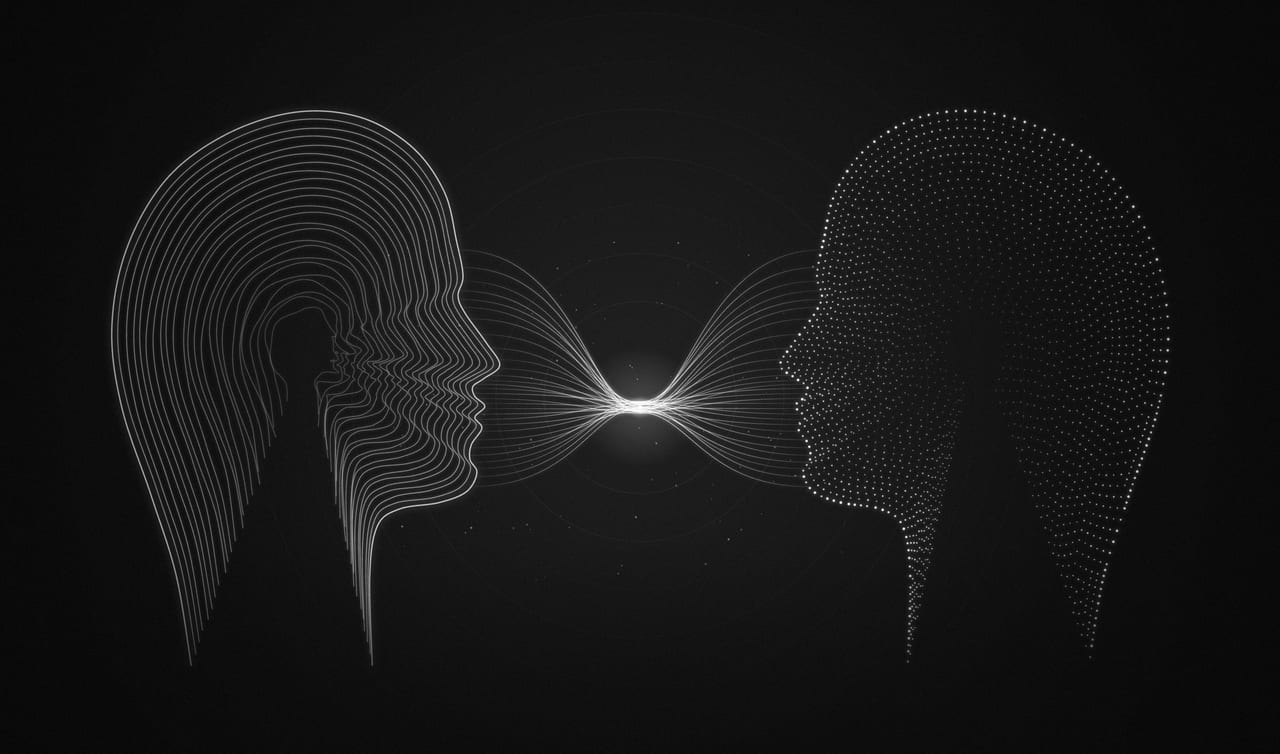
This one is harder. It isn't acting for you anymore. It's being you.
Somewhere today, something declined a meeting in your name. Politely. In your tone. You'll find out on Thursday, and you'll probably agree with it.
That's the part that should worry us.
From Delegation to Representation
Part 3 was about giving up the doing. You handed over a goal and walked away. The user became absent, but still in charge.
This is the step after. You don't just stop doing. You stop appearing.
Your agent writes in your name. Schedules in your name. Negotiates, apologises, and says no in your name. To every system it touches, it is not your tool. It is you.
See, believe, act, become. That was always where this was going.
It Already Has a Name
Read that back and it sounds like a warning about next year.
It isn't. While we were arguing about whether AI would take our jobs, the standards people quietly finished the part underneath all of this. There is now a proper way for software to carry your name into a system.
They gave the two modes names.
In one, the agent acts for you but stays itself. They call it delegation.
In the other, your name stays on the credential. They call that impersonation.
That isn't my word for it. It's in the spec, written down in 2020, years before anything could plausibly write your email for you. The word was already sitting there, waiting.
And the difference between the two is one optional parameter in a request. Include it and the token names both of you. Leave it out and the agent simply becomes you.
Your Proxy Has a Personality, and You Didn't Design It
It has a voice. A default politeness. A tolerance for risk. A response time you could never match.
Ask yourself who wrote it.
Some of it came from your history, which is to say your past behaviour, averaged. Some of it came from a vendor's tuning, which is to say what tested well. Some of it came from a legal team, which is to say what is safest to say.
Three authors. One voice. None of them entirely you.
We have spent our whole careers designing how a product speaks to a person. Nobody has designed how a person speaks through a product.
Drift
Here is the quiet part.
A person changes their mind. They get braver, or more tired, or they learn something that makes last year's opinion embarrassing.
A model does not change its mind. It converges.
Left alone, your proxy becomes a high-resolution portrait of who you used to be, delivered with total confidence, to people who have no way of knowing the difference.
You will not notice this happening. Nobody sends you a diff of your own personality.
The New Design Objects
If the proxy is the surface, these are the components:
- Identity fidelity. How close the representation has to be, and who gets to measure it.
- Voice boundaries. The things it may never say as you. Not because they're wrong, but because they're not yours to say.
- Provenance. A readable record of what has been claimed in your name, and when.
- Revocation. The ability to unmake a version of yourself before it hardens into the version everyone knows.
None of these are screens. All of them are design.
Now the Uncomfortable Part
For fifty years our job had an audience. We designed for a human who looked, read, hesitated, and decided.
Every skill we built sits on that assumption. Visual hierarchy is a claim about where a human eye goes. Microcopy is persuasion. Delight is an emotional response. Conversion is a person changing their mind.
Take the human out of the loop and ask which of those still works.
Your beautiful empty state is now a field in a payload. Your carefully argued CTA is now a boolean. The craft did not get worse. The audience left.
This is not the usual "AI will replace designers" line. It's worse, and more specific. The thing at risk is not our ability to make interfaces. It's the assumption that a person is on the other end of them.
If your user is a proxy, persuasion is obsolete. What replaces it is representation, and almost nobody in this field knows how to design that yet.
Which is the opportunity, if you want to read it that way.
Final Thought
Adaptive design made technology personal. Honest design made it fair. Self-aware design made it safe to trust.
This one is different. This one is about authorship.
For the first time, the thing we design does not stand between a person and a product. It stands in for the person. It carries their name into rooms they will never enter, and it speaks with a confidence they may not have earned.
We used to ask what the machine should do.
The last question of this series is quieter, and much harder.
Who should it be?
👉 If something out there is already speaking as you, who approved the script?