

Amplus
One open-data platform, sold to two kinds of buyer, governments and companies, each starting the way they can buy.
Back to Work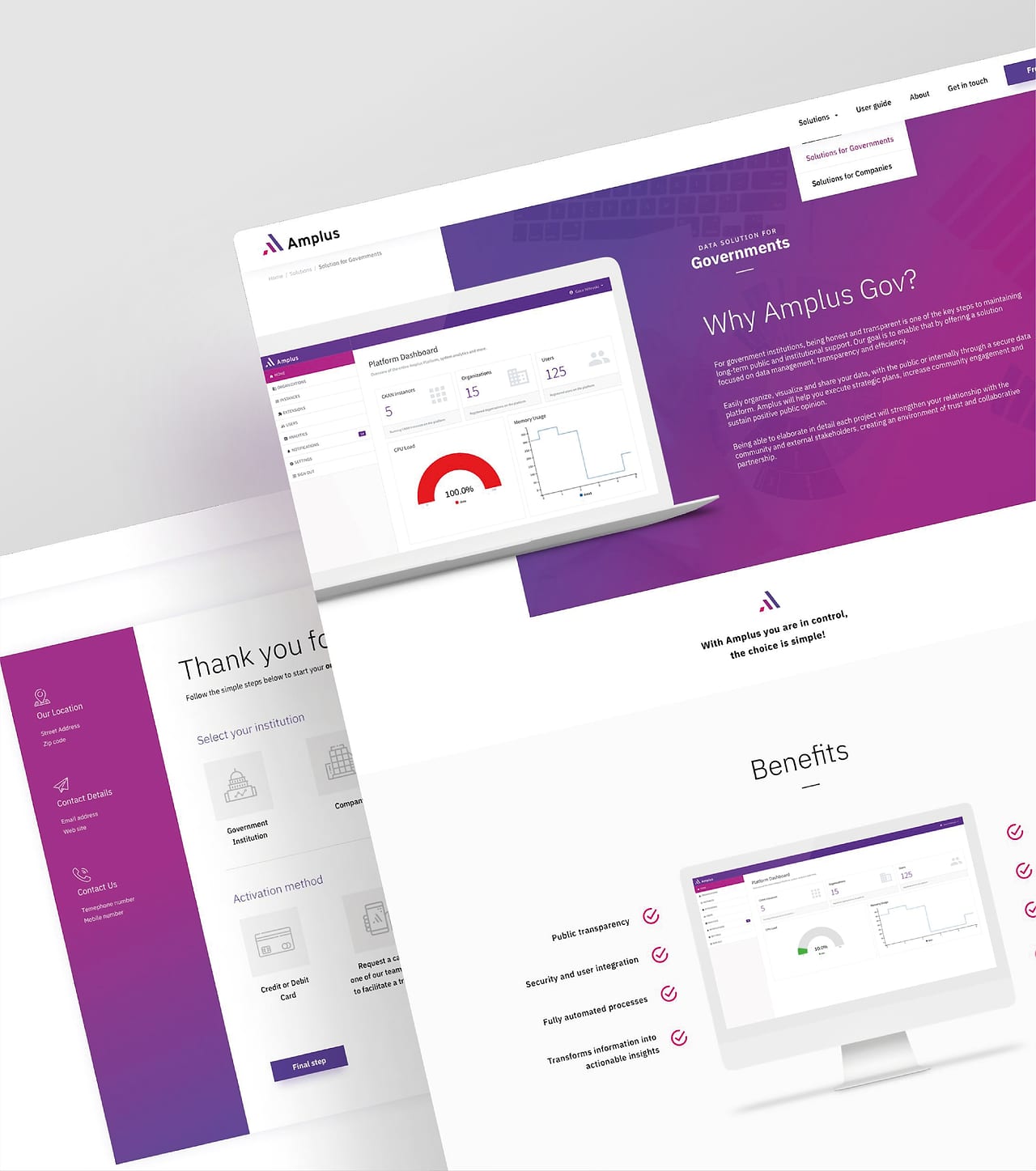
Keitaro built Amplus to run CKAN open-data portals as a service for two buyers, governments and companies. A company can often pay by card and start, while a public institution is more likely to need a conversation first. I created the brand and designed the site, sign-up and dashboard, so each buyer starts the way they can buy, then sees the platform running.
In numbers
These are product scope numbers from the delivered design, not its dashboard values, which are mock data. Sign-up and usage data belong to Keitaro, so they are not shared here.
The problem
Keitaro is known for CKAN, the open-source software behind many government data portals. Amplus turned that know-how into a product: a SaaS platform that runs CKAN instances for its customers. A government or a company gets a working data platform without running CKAN itself. But a product has to sell itself in a way a services project does not.
That product had two buyers. Governments need to publish data and keep the public's trust. Companies want their own data managed efficiently across departments. They buy differently too. A company can often pay by card and start, while a public institution is more likely to need a conversation and a purchasing process first. Both would be trusting their data to a platform they do not run.
One platform had to make each buyer's case, let each start the way they can buy, and show that it is running.
Goals
-
One platform, two buyers
Governments and companies each find their own reason to choose Amplus, while Keitaro builds and runs a single product.
-
A start that fits how each buys
A company can pay by card and start, and an institution that needs a conversation first can ask for one.
-
Trust in a platform they do not run
Admins see what the platform is running and how it is performing from the first screen of the dashboard.
My role
Amplus was one of Keitaro's in-house products, so the business I designed for was my own employer's. I worked with product managers, engineers and content strategists, and designed both sides of the product: the site and sign-up that sell it, and the dashboard admins use once they are in.
Most of the work was packaging: how one platform is offered to two buyers, how each gets started and what they see first.
- Framed one CKAN platform for two buyer types, with separate Solutions pages for governments and companies.
- Designed a sign-up that asks for the institution type first, then offers a card or a call with the team.
- Defined the Platform Dashboard home around platform health: CKAN instances, organizations, users, CPU load and memory usage.
- Organized the dashboard navigation around what admins manage: organizations, instances, extensions and users.
- Put the product on the marketing pages, with the dashboard next to the case for Amplus Gov and its benefits.
- Created the Amplus brand identity, plus the component library and design system behind the product.
Product decisions
-
Sell one platform through two front doors
Governments and companies come to Amplus for different reasons. The navigation splits Solutions into Governments and Companies, and each page makes its own case. The government page argues for transparency and long-term public support. Both doors lead to one sign-up, which first asks whether the buyer is a government institution or a company.
Trade-off: Two sets of pages and messages to keep current for one product. Worth it, because a government and a company do not buy for the same reasons.
-
Let each buyer choose how to start
The sign-up does not decide for the buyer how they pay. After the institution type, it offers two activation methods side by side: a credit or debit card, or a call with one of the team. Neither is tied to the buyer type, since a small agency may hold a card and a large company may want to talk first.
Trade-off: Calls take the team's time and make the start slower than a card. Without them, a buyer who cannot pay by card would have no way in.
-
Show platform health on the first screen
The brand line tells buyers they are in control, and the dashboard is where that has to be true. Its home screen opens on the platform's state: running CKAN instances, registered organizations and users, CPU load and memory usage. The marketing pages show the same dashboard before anyone signs up.
Trade-off: Strain shows too, like a CPU gauge in the red. For a buyer deciding whether to trust Amplus, seeing the real state was worth more than a calm screen.
-
Organize the product around what admins manage
In Amplus, a CKAN instance can belong to one or more organizations and runs a set of extensions, and users can belong to several organizations. The dashboard navigation follows that model. Organizations, Instances, Extensions and Users each have a place in the sidebar, next to Analytics, Notifications and Settings.
Trade-off: CKAN terms like instances and extensions ask more of a newcomer. They match how the data teams who run portals already work.
Impact
-
For Keitaro
One CKAN platform offered to governments and companies alike, with a sales conversation only where a buyer needs one.
-
For governments and companies
A case made for their own situation, a way to start that fits how they buy, and a dashboard that shows what is running.
-
For the team
A brand identity and component library that new pages and platform features can start from.
What I'd do next
The open question is how governments start. If most of them ask for a call, the next bet is a quote or invoice path they can begin online. To know, I would track sign-up to activation for each buyer type, the share who choose a call over a card, and the time from a call request to a first running CKAN instance.