

Range of Motion Study
A baseline measured the same way for every athlete, in one guided session that leads into the next study.
Back to Work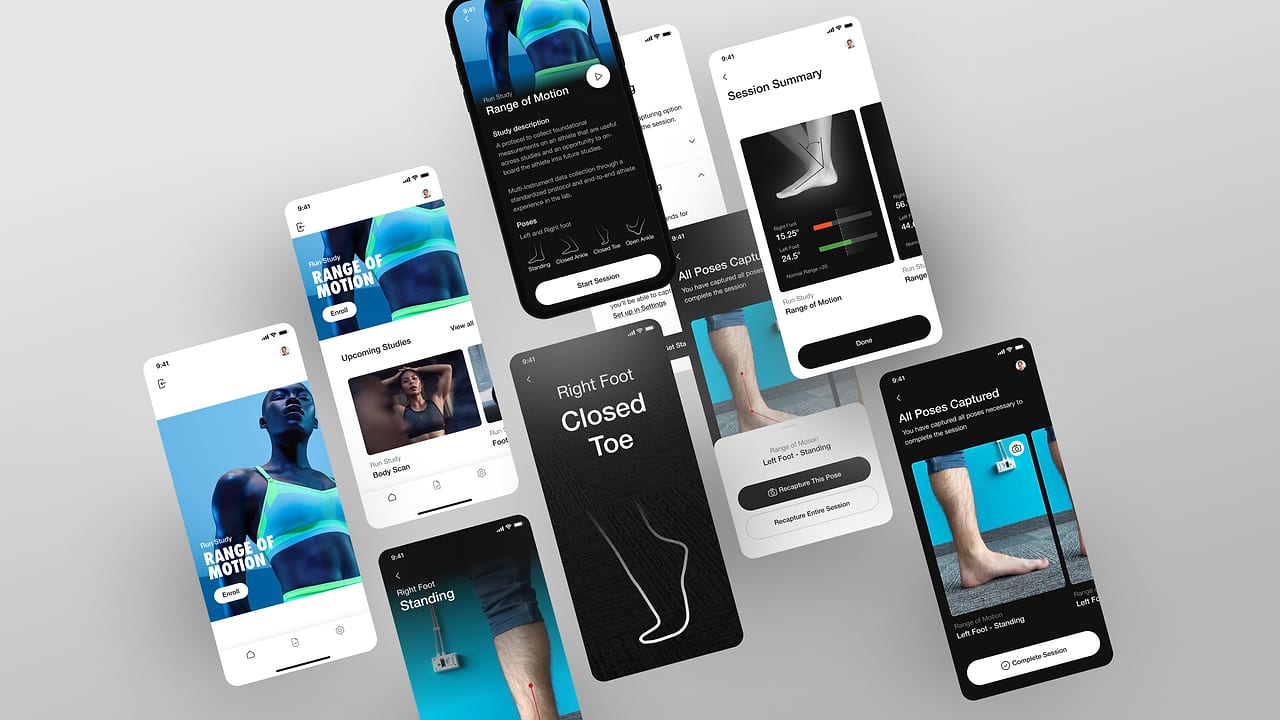
A baseline, such as each ankle's range of motion, can serve many studies only if every athlete is measured with the same protocol. For a global sportswear leader's sports research lab, I turned that protocol into a guided iPhone session: eight camera captures and a review before the athlete leaves. Results show measurements, not diagnoses, and lead into the next study.
In numbers
These are product scope numbers from the delivered design. Measurements and study data belong to the client, so they are not shared here.
The problem
The lab runs several studies with the same athletes, and each one needs the same starting point: measurements such as the range of motion of each ankle. A shared baseline only works if every athlete is measured the same way. Captures taken in a different pose, or from a different angle, cannot be compared, and no study can build on them.
The captures come from a phone camera, during one visit to the lab. A weak capture is easy to miss in the moment and costly to find later: it means another visit or a gap in the data. Athletes also see their results, and those results had to stay measurements, not medical judgments.
So the product had two jobs. Make the protocol hard to run any other way, and make the end of one study the start of the next.
Goals
-
A baseline every study can use
The same eight captures for every athlete, so measurements compare across athletes and carry over from one study to the next.
-
Done right in one visit
Weak captures found and fixed before the session completes, so no athlete has to come back to redo one.
-
Results without medical judgment
Each foot shown against a normal range, with no diagnosis or advice attached.
-
A first study that leads to the next
A session that brings athletes into the lab's upcoming studies, instead of ending at the results.
My role
I was the Senior Product Designer on the app, working with the product manager and engineers. I owned the experience from enrollment to results: the session's flow, its rules and what athletes see at the end. It was one of three products I designed for the lab, with the Sports Science study app and Everyday Training.
The work sat between two groups. Researchers needed every capture taken the same way. Athletes needed to know which pose came next, how to hold it and when they were done.
- Turned the lab's measurement protocol into product requirements and one fixed session flow, with the PM and engineers.
- Defined what a complete session is: all eight poses captured, then reviewed on one screen before Complete Session.
- Scoped the results to measurements against a normal range, and left the interpretation to the researchers.
- Connected the session to the wider program: Enroll on home, Upcoming Studies, and a study page that explains the protocol first.
- Designed the pose guidance, the camera capture with angle markers, the review with recapture options and the Session Summary.
Product decisions
-
Run one protocol for every athlete
Comparable data starts with an identical session. Every athlete gets the same eight captures, four poses per foot, guided one at a time. Each begins with a drawing of the pose, then a live camera view where computer vision marks the shin and foot. A session can only be completed once every pose is captured.
Trade-off: A fixed path leaves no room to adapt the session to one athlete. Numbers that compare across every athlete were worth more.
-
Fix weak captures before the athlete leaves
The cheapest moment to fix a capture is while the athlete is still in the lab. So the session ends on a review, not on the last photo. All Poses Captured shows every capture, labeled by foot and pose. From any capture, the session offers Recapture This Pose or Recapture Entire Session. Complete Session is the last step.
Trade-off: The review adds time to every session, including the ones with no weak captures. A second visit to fix one photo would cost far more.
-
Report measurements, not diagnoses
Athletes see their results at the end of the session, which raises the question of what to tell them. The Session Summary shows each measurement in degrees, right and left foot side by side, against a normal range. A value outside the range stands out. It gives no score and no advice. What a number means for an athlete is a question for the researchers.
Trade-off: Athletes get less explanation than they might want. Keeping interpretation with the researchers keeps the app from giving medical advice.
-
Make the end of one study the start of the next
The protocol had a second purpose: bringing athletes into future studies. So the app is organized around studies, not a single test. Home pairs the current study and its Enroll button with Upcoming Studies, such as a body scan. The study page explains what the session collects and why before Start Session, a path that later studies can reuse.
Trade-off: Athletes pass through Enroll and the study page before the first capture. Knowing what the session is for was worth the extra steps.
Impact
-
For the lab
One protocol, run the same way for every athlete, gives its studies measurements they can compare and reuse. Weak captures are caught before a session completes, not after the athlete has gone.
-
For athletes
A guided session with a clear end, results for both feet, and the next studies waiting on home.
-
For the team
One definition of a complete session, eight captures reviewed, that the PM and engineers could build and test against.
What I'd do next
Every recapture is a sign that the pose guidance fell short, so that is where I would look first. With the researchers, I would track how often each pose is recaptured, how many sessions finish without a full restart and how many athletes join a second study. The first two show which guidance needs work. The last shows whether the session does its second job.