

Genetic Data Hub
Screening data that scientists can find, trust and judge before they download a single file.
Back to Work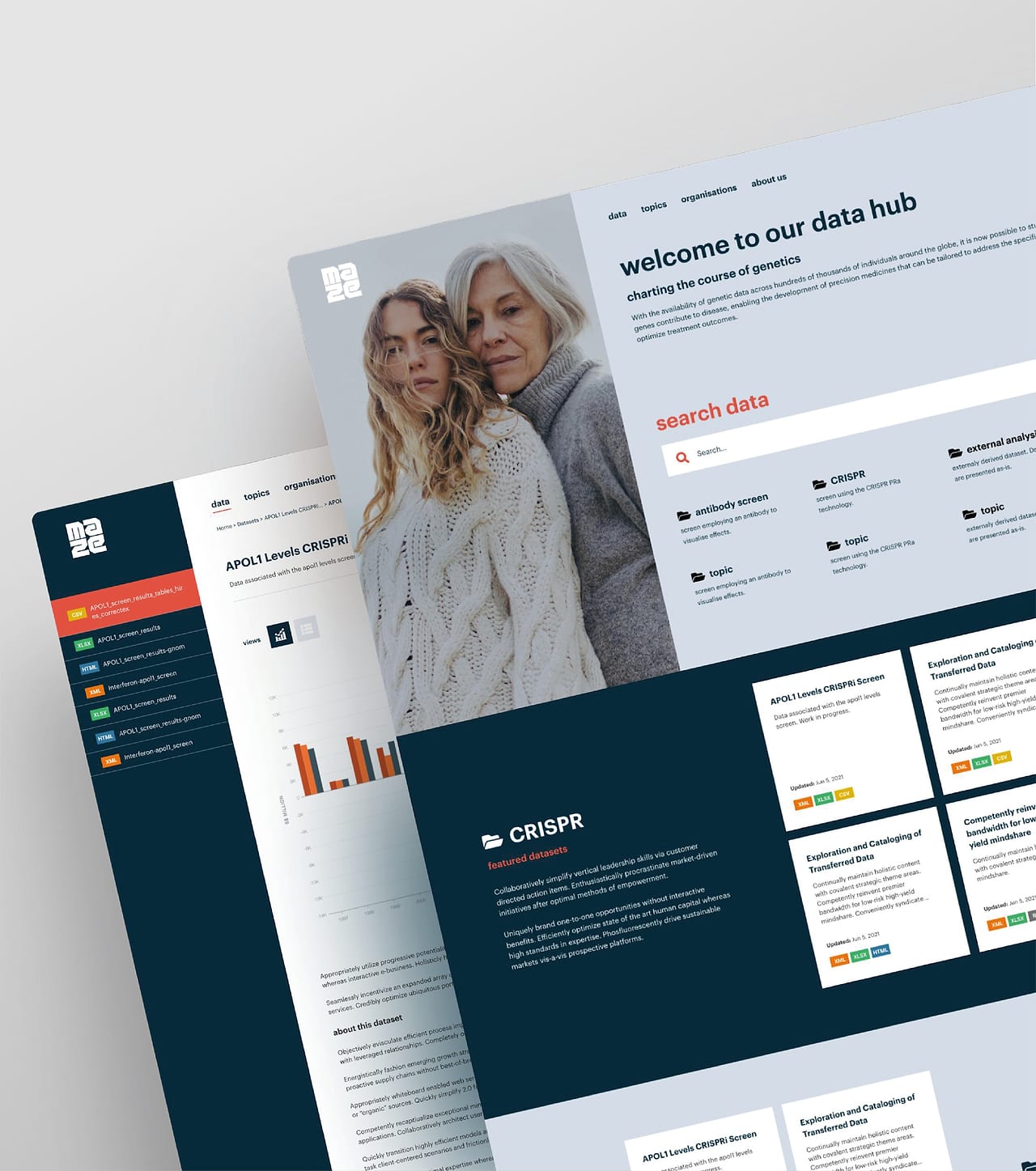
A dataset nobody can find, or nobody trusts, informs no research decision. For a precision-medicine biotech company running antibody and CRISPR screens, I designed a data hub organized by experiment type. Before downloading a single file, scientists can preview a dataset and judge its freshness, format and origin.
In numbers
These are product scope numbers counted from the delivered design. Usage data belongs to the client, so it is not shared here.
The problem
The company runs its own antibody and CRISPR screens and adds datasets derived by outside groups, in CSV, XLSX, XML and HTML files. That data is an asset only when it shapes the next research decision. A dataset nobody can find, or nobody trusts, informs nothing.
The people using the hub are scientists deciding whether a dataset deserves their time. Before downloading, they need to know what kind of experiment produced it, how current it is, what format its files are in and whether the company stands behind it. A file name answers none of that.
The measure of the hub was decisions, not storage: how quickly a scientist reaches the right dataset, and how much they can judge about its freshness, origin and fit before downloading anything.
Goals
-
Less time to the right dataset
Scientists reach a relevant dataset from the home page, through search or an experiment type, without knowing a file name first.
-
Trust in freshness and origin
Every dataset shows when it was last updated, and work from outside the company is marked as presented as-is.
-
Judge relevance before download
A description, a preview and a list of tagged files let scientists rule a dataset in or out without downloading it.
My role
I was the product designer on the hub, working with product managers and engineers toward the client's and the scientists' goals. My part was the catalog structure, the path from search to a single file and the interface.
The hard limit was upkeep. Every field a scientist relies on before a download is a field the company has to keep accurate for every dataset it publishes.
- Centered the hub on three needs: reaching the right dataset fast, trusting its freshness and origin, and judging it before download.
- Organized the catalog by experiment type, with search beside it and topics and organizations in the navigation as other ways in.
- Defined what every dataset card shows: a short description, the last-updated date and a tag for each file format.
- Mapped the path from the home page down to a single file, mirrored in the breadcrumb on every dataset page.
- Designed the home page and the dataset page, from high-level mockups to prototypes.
Product decisions
-
Organize the catalog by experiment type
A scientist starts from the kind of experiment, not a file name. The home page pairs a search box with an entry point for each dataset type: antibody screen, CRISPR and external analysis. Each has a one-line definition, and featured datasets appear under their type, such as CRISPR. Topics and organizations in the navigation give two more ways in.
Trade-off: A fixed set of types needs curating as new kinds of screens arrive. In return, every new dataset lands where scientists already know to look.
-
Show freshness and format on every card
Whether a dataset is current, and whether its files fit a scientist's tools, decides if it is worth opening. Every card carries the last-updated date and a tag for each format: CSV, XLSX, XML or HTML. A description can also flag a dataset as a work in progress. Scientists rule datasets in or out from the list itself.
Trade-off: Every card depends on accurate dates and formats from whoever publishes the data. Without them, the only way to check a dataset is to download it.
-
Preview the data before the download
A download is a slow way to learn a dataset is the wrong one. Each dataset gets one page with its description, its files listed with format tags and a views switch between a chart and a table. A breadcrumb runs from Home through Datasets to the dataset and the open file, so stepping back never means starting over.
Trade-off: Chart and table views cost more to build than a list of download links. They are what let a scientist judge relevance without leaving the page.
-
Mark outside work as presented as-is
Not every dataset comes from the company's own screens. Externally derived data has its own type, and its definition says the data is presented as-is. Scientists see where a dataset came from before they open it, and the hub is clear about which work the company stands behind.
Trade-off: Outside datasets carry a caveat that in-house screens do not. For a scientist, clear provenance is worth more than a catalog where every dataset looks equal.
Impact
-
For the company
One catalog where every dataset, in-house or external, is typed, dated and labeled, so it can inform decisions beyond the team that produced it.
-
For scientists
A short path from search or experiment type to a dataset they can judge on one page, before downloading a single file.
-
For the team
One card and one dataset page for every experiment type. A new kind of screen needs a new entry point, not a new design.
What I'd do next
The next bet would be dataset versions, so a scientist can see what changed since their last download. To know the hub works, I would watch time from the home page to a first download, searches that return nothing and dataset pages left without a download. Together they show whether scientists reach the right data faster and rule out the wrong data sooner.