

MindsDB
Machine learning inside the database was a new category. The site showed where it fits and gave every visitor a next step.
Back to Work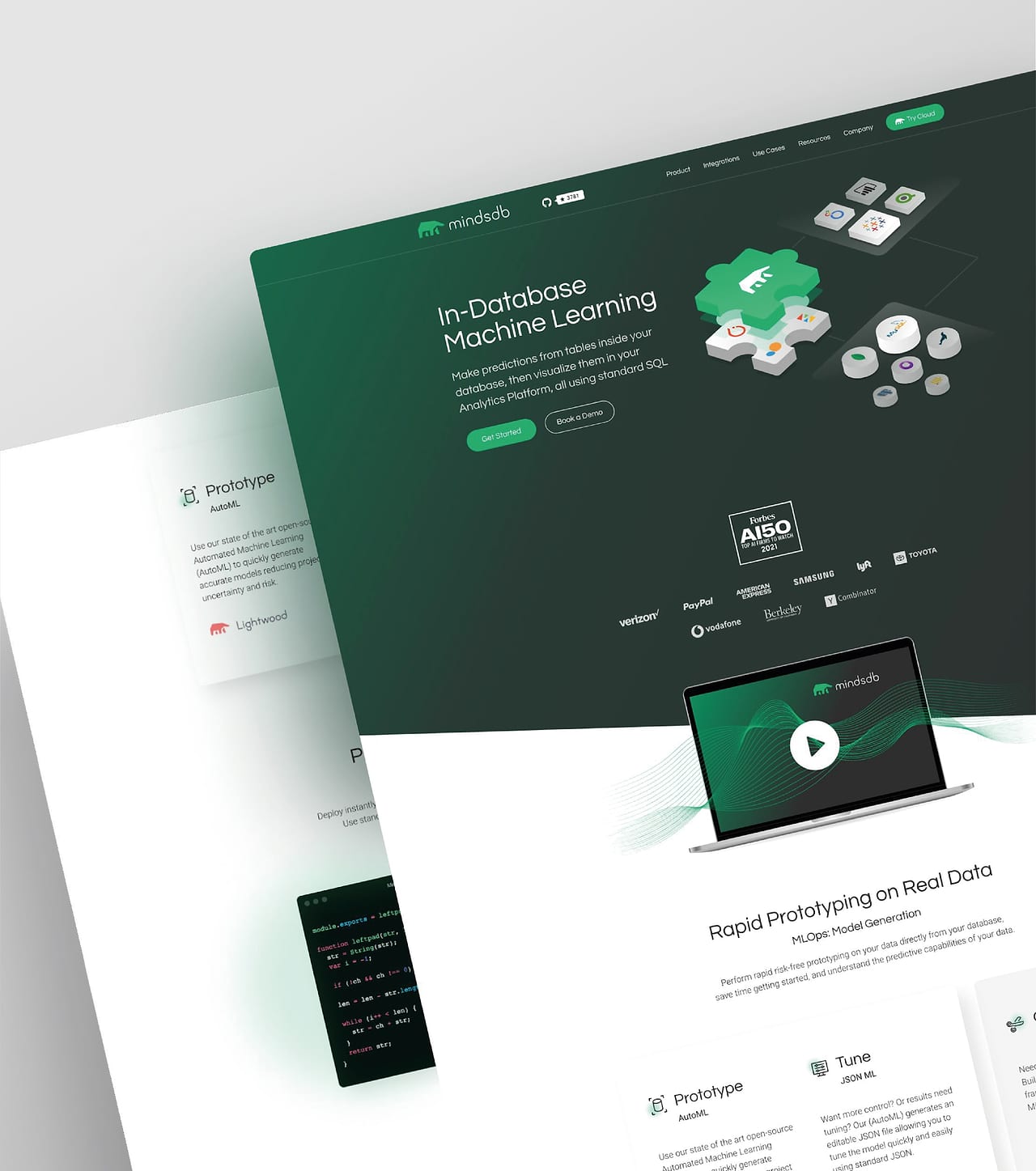
MindsDB, a 2021 Forbes AI 50 company, brought machine learning into the database, a category its visitors had no ready picture of. I designed the website to place MindsDB in the stack a team already runs and to put proof where each audience has doubts. From the first screen, every visitor has a next step: the free install, the hosted cloud or a sales demo.
In numbers
These are product scope numbers counted from the delivered design, since traffic and sign-up data belong to MindsDB and are not shared here.
The problem
In MindsDB, a model is created and queried with SQL, like a table, and its predictions can flow on to the BI tools a team already uses. In 2021 the company was growing an open-source community while adding paid paths: a hosted cloud and support for enterprise teams. The website had to open all of those paths, and a visitor who left confused was lost to every one.
Visitors arrived with different questions. Developers wanted to install it, read the code and see whether the project was alive. Data and business leaders wanted to know where it fit in their stack, who else trusted it and whom to talk to. The category was new, somewhere between a database, an ML platform and a BI tool, so neither group had a ready picture of it.
Two things had to land in seconds: MindsDB as part of the stack a visitor already runs, and a next step for each intent, free or paid.
Goals
-
Understood from the first screen
A visitor can tell what MindsDB does, and where it sits in their own stack, from the hero alone.
-
A next step for every intent
Developers, cloud users and buyers who want a conversation each find their own call to action.
-
A free path that stays first
The paid paths grow without hiding the open-source install that builds MindsDB's community and credibility.
My role
I designed the website as a Product Designer, working with the MindsDB team. I owned the page structure and message hierarchy, the calls to action, where proof sits and the illustrations that show where the product fits, through to the final UI.
Three groups pulled on the same page: developers who want to try it alone, buyers who need proof and a person to talk to, and a business growing paid paths from an open-source base.
- Mapped visitors by intent and gave each one a call to action on the first screen: self-serve, hosted cloud or a sales demo.
- Structured the home page around one promise, predictions with standard SQL inside the database, before any feature.
- Placed proof where each audience starts to doubt, from GitHub stars in the header to the badge and logos under the hero.
- Ordered the feature sections as the ML workflow: generate a model, tune it or bring your own, then deploy it.
- Designed the isometric illustrations that place MindsDB between a team's databases and BI tools, and the final UI.
Product decisions
-
Give each intent its own path
Each call to action matches a way MindsDB is adopted. Get Started is the self-serve path, led by the free open-source install. Try Cloud, in the header, leads to the hosted product. Book a Demo leads to a conversation with the team. Developers can start without a sales form, and buyers can skip the install steps.
Trade-off: Three calls to action compete on one screen. Get Started got the only filled button in the hero, because the free path builds the community the paid paths grow from.
-
Show where it fits, not how it works
The category was new to most visitors. Instead of explaining models, the hero illustration places MindsDB in a stack the visitor already runs. Six databases, including MySQL, PostgreSQL and MongoDB, feed MindsDB, and its predictions reach Tableau, Power BI, Looker and Qlik. Visitors spot their own tools before reading a word about AutoML.
Trade-off: The picture says nothing about model quality or how AutoML works. That detail moved down the page, after the promise and the proof.
-
Put proof where each audience doubts
Developers judge an open-source project by whether it is alive, so the GitHub star count sits in the header, next to the logo. Leaders judge a young vendor by who else backs it, so the Forbes AI 50 badge and a row of known company and backer logos come straight after the hero, before any feature.
Trade-off: Proof pushed the product story further down the page. For a young company in a new category, credibility had to come first.
-
Order the features as the ML workflow
Applied machine learning stalls in two places: generating a model and moving it into production. The page follows that order. Model generation comes first, as three cards sorted by how much control a team wants: Prototype with the open-source AutoML engine, Lightwood, Tune its generated JSON, or bring a model from any framework. Deployment follows.
Trade-off: A workflow gives a scanning buyer no single feature list. In exchange, each card answers the question a team has at that step.
Impact
-
For MindsDB
One site for the open-source community and the paid paths alike: the free install, the hosted cloud and a sales conversation, each reachable from the first screen.
-
For developers
A quick answer to what MindsDB is, a live sign that the project is active, and a way to try it without talking to anyone.
-
For data and business leaders
A picture of where MindsDB fits between their databases and BI tools, proof of who backs it, and a direct way to book a demo.
What I'd do next
My first check would be a first-click test of the hero with developers and data leaders. After launch, I would measure each path: clicks on Get Started, Try Cloud and Book a Demo, cloud sign-ups that start on the site, and demo requests that become qualified conversations. Together they show whether each intent finds its path, and which proof to move next.